
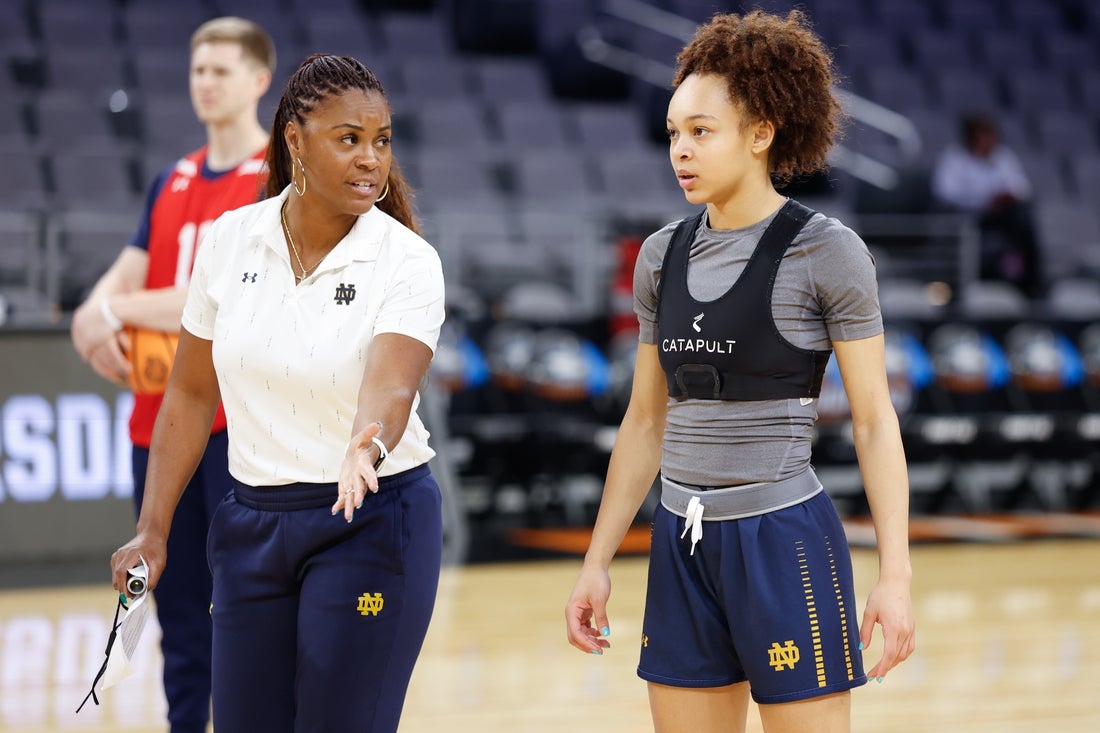
Notre Dame brought back just three players from the team that walked off the court last March. And there were times Fighting Irish coach Niele Ivey wondered aloud whether all the pieces could fit together in time for the Final Four in Phoenix.
But with 10 losses in the rearview mirror, No. 6 seed Notre Dame doesn’t mind crashing a few more parties starting Friday with a Fort Worth Region 1 semifinal matchup with Vanderbilt.
“Not a lot of people believed in us to get here,” Cassandre Prosper said Thursday of Notre Dame’s season to date. “For me, especially coming back here with Notre Dame, Sweet 16, you know, we’ve been here five years in a row. I think this year is especially special because we came a long way. I think we had seven transfers and then we were only three returners coming back to Notre Dame, so just to see the journey that we’ve had and the growth that we’ve had to be back in this moment right here is really — I think it’s just a great opportunity. It’s beautiful to see our growth really as a team.”
Hannah Hidalgo, the No. 3 scorer in women’s basketball this season at 25.2 points per game, has been the driving force for the Irish as one of three players back from 2024-25. She was voted ACC Player of the Year and ACC Defensive Player of the Year, and Notre Dame will need her to show her many skills to slow Mikayla Blakes and Vandy.
Blakes, the SEC Player of the Year, led the nation in scoring (27 ppg) and did it for the Commodores with what Hidalgo described as Caitlin Clark-level scoring.
She scored 30 points in 29 minutes to open the NCAA Tournament with Vandy’s 102-61 rout of High Point and put up 25 points, 10 rebounds and nine assists in a 75-57 win over Illinois.
“Obviously we all know she’s the No. 1 scorer in the country, but just the way she’s able to put the ball in the hoop, it’s unlike I feel like I’ve ever seen,” Hidalgo said of Blakes. “Like Caitlin type of level. She can score on all three levels, whether that’s getting all the way to the basket, her midrange or her three. Of course, that’s always tough to guard.”
Notre Dame’s Iyana Moore, who spent four years at Vanderbilt and transferred to Notre Dame for her final season, has the unique inside perspective from both sides. She and Hidalgo helped funnel Notre Dame’s focus with a “Why Not Us?” mindset in the tournament.
“They’ve established a confidence in themselves and in our group, in our identity,” Ivey said. “It took us a while to kind of really have that consistent identity. We were working through it a lot this season. You know, you can see that they’ve really established that confidence they have in their individual game, but also that trust and confidence that they’ve created amongst each other. I credit Hannah for that. Hannah is somebody that comes in with that confidence. You can tell that they’re feeding off of her energy.”
–UConn coach Geno Auriemma trumpeted the infinite growth in women’s sports participation, coverage and overall interest during the 2025 Women’s NCAA Tournament.
But he wondered aloud Thursday if the NCAA was planning to acknowledge the elimination of Title IX, legislation in place to maintain balance in men’s and women’s sports and scholarship opportunities.
Noting recent headlines about the University of Kentucky spending $22 million on its men’s basketball roster, Auriemma considered the news confirmation of what he already knew and players felt.
“It appears to me that at the big conferences level, I think Title IX legislation is probably over. I don’t know that when you say we’re allocating $20.5 million that they’re going, yeah, well, you know, women’s basketball is going to get the same amount as football and men’s basketball,” Auriemma said.
“I think that Title IX legislation over the last couple of years is pretty much out the window. I’m sure there’s some schools that are trying really hard to stay with that in terms of numbers, you know, scholarship opportunities for people, but when it comes time for funding and putting money into those programs that would make you believe that it’s the same, I don’t see that as much anymore as I did in the beginning.
“I think most of the NCAA laws have gone out the window as the conferences have kind of consolidated the power that they have over the NCAA for the most part. And the way the women’s game has grown, it’s grown at a lot of places, and those places where it’s grown have got to keep pushing for more, because I don’t know that we’re quite there yet.”
For a real-time measure of the women’s game still lagging behind the NCAA Tournament on the men’s side, Auriemma continues to exclaim displeasure with the arrangements for on-court workouts and media. He said his team was granted 30 minutes on the court and the schedule called for their shootaround at dawn and media availability before 8 a.m.
“The players used to be the main thing back in the day, and now that’s all changed,” he said. “The idea of having — that the committee has to run a tournament with eight teams in one site and try to get all eight of them to actually prepare for the biggest games, it just makes no sense at all. … Again, in an era where financially you have to make everything work, that seems to be the No. 1 question or the No. 1 concern that everyone has: How do we make this work financially? I’m OK with that. How do we do that and still make it work for the players as well?
–Field Level Media

